Direct Answer: Can You Claim Home Loan Tax Deductions in the New Tax Regime?
"If I have an ongoing home loan, can I claim deductions for interest (Section 24b) and principal repayment (Section 80C) under the New Tax Regime in Tax Year 2026-27?"
Short Answer: No, for a self-occupied property, you cannot claim these deductions in the New Tax Regime. Under the New Tax Regime governed by the Income Tax Act, 2025, neither the Section 24(b) interest deduction (up to ₹2,00,000) nor the Section 80C principal deduction (up to ₹1,50,000) is allowed for a self-occupied residential home.
However, the New Tax Regime compensates by offering much lower slab rates, a ₹75,000 standard deduction for salaried taxpayers, and a full Section 87A rebate providing zero tax on taxable income up to ₹12,00,000 (which covers salaried incomes up to ₹12.75 Lakh CTC).
This creates a major financial decision: At your specific salary level, does the Old Tax Regime with home loan deductions save you more money, or does the New Tax Regime's zero-tax / lower-slab structure win? We provide the complete mathematical breakeven analysis and a worked ₹50 Lakh home loan case study below.
The Reality of Home Loan Tax Deductions: Old vs New Regime Breakdown
Historically, taking a home loan in India was considered the ultimate tax-saving maneuver. Salaried taxpayers routinely used home loan interest and principal repayments to shield over ₹3.5 Lakh to ₹4 Lakh from income tax every year. Here is how both tax systems treat home loans in Tax Year 2026-27:
Deductions Permitted
-
✔
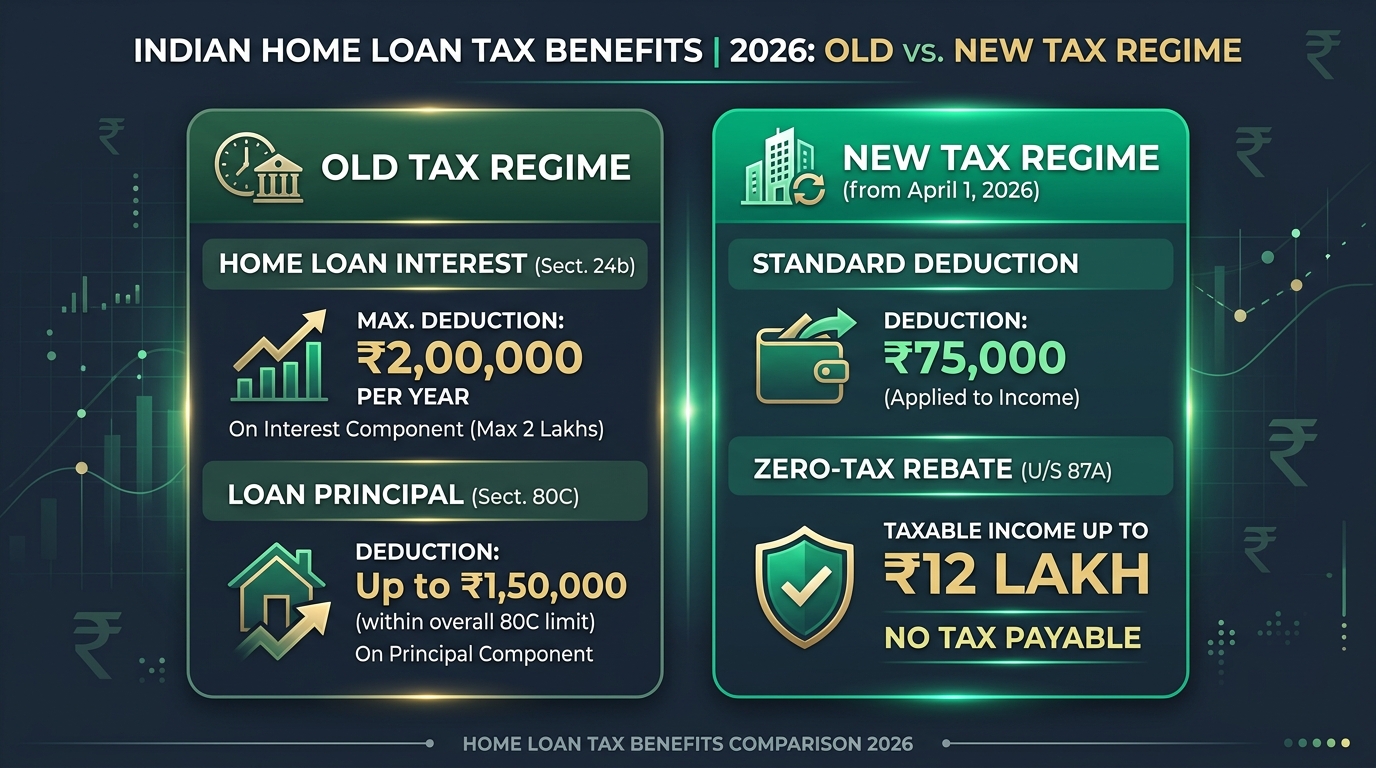
Section 24(b) (Interest): Deduct up to ₹2,00,000 per financial year on home loan interest for a self-occupied property.
-
✔
Section 80C (Principal): Deduct up to ₹1,50,000 on principal repayment (clubbed with EPF, PPF, ELSS, life insurance).
-
✔
Standard Deduction: ₹50,000 for salaried employees and pensioners.
-
✔
Stamp Duty & Registration: Claimable under Section 80C in the year of purchase (within the overall ₹1.5L ceiling).
-
✔
Additional Deductions: Section 80D (Health Insurance up to ₹75k), NPS (₹50k under 80CCD(1B)), and HRA exemption.
Default System Rules
-
✖
Section 24(b) (Interest): ₹0 deduction for self-occupied property. No interest deduction allowed against salary.
-
✖
Section 80C (Principal): ₹0 deduction. Principal payments provide zero tax benefit.
-
✔
Standard Deduction: Enhanced to ₹75,000 (higher than Old Regime's ₹50,000).
-
✔
Section 87A Rebate: ₹0 tax up to ₹12 Lakh taxable income (effective ₹12.75L gross salary for salaried individuals).
-
✔
Lower Progressive Slabs: Slabs range from 5% to 25%, with the peak 30% rate applying only above ₹24 Lakhs.
The Exception: What About Rented / Let-Out Property in the New Tax Regime?
There is an important statutory distinction that many taxpayers misunderstand regarding let-out (rented) properties under the New Tax Regime:
The Catch: Under the New Tax Regime, if the interest deduction exceeds the net rental income (resulting in a "Loss from House Property"), this loss cannot be set off against your salary, business income, or other income heads. It can only be carried forward for up to 8 assessment years to be set off exclusively against future income from house property. In the Old Tax Regime, by contrast, you can set off up to ₹2,00,000 of house property loss against your active salary income each year.
The Statutory Breakeven Formula: When Does the Old Regime Win?
To decide whether to opt for the Old Tax Regime solely because of your home loan, you must understand the Total Deduction Breakeven Threshold.
The New Tax Regime provides a default ₹75,000 standard deduction and significantly wider, lower tax slabs. Therefore, claiming home loan deductions under the Old Tax Regime only makes financial sense if your total aggregate deductions (Standard Deduction + Home Loan Interest + 80C Principal + Health Insurance + NPS) produce tax savings that exceed the structural slab advantage of the New Tax Regime.
Total Old Regime Deductions = Standard Deduction (₹50k) + Section 24b (Up to ₹2L) + Section 80C (Up to ₹1.5L) + Section 80D + NPS
Maximum Standard Homeowner Deduction = ₹50,000 + ₹2,00,000 + ₹1,50,000 = ₹4,00,000
Rule 1: If Gross Salary <= ₹12.75 Lakh → New Regime ALWAYS wins (Tax is ₹0).
Rule 2: If Gross Salary is ₹15 Lakh → Old Regime requires > ₹4.75 Lakh deductions to beat New Regime.
Rule 3: If Gross Salary is ₹20 Lakh → Old Regime requires > ₹5.25 Lakh deductions to beat New Regime.
₹50 Lakh Home Loan Worked Example — Step by Step
Let us calculate the exact tax outcome for a borrower with a ₹50 Lakh home loan at an interest rate of 8.75% for 20 years.
Home Loan Baseline Parameters:
- Loan Amount: ₹50,00,000
- Interest Rate: 8.75% per annum (floating)
- Tenure: 20 Years (240 monthly installments)
- Monthly EMI: ₹44,186 (Check via our ₹50 Lakh EMI Amortization Schedule)
- Year 1 Total Payment: ₹5,30,232
- Year 1 Interest Paid: ₹4,33,874 (Capped at statutory ceiling of ₹2,00,000 under Section 24b)
- Year 1 Principal Repaid: ₹96,358 (Eligible for Section 80C)
Case 1: Salaried Employee with ₹15 Lakh Gross CTC
Assume the employee utilizes the full ₹2 Lakh home loan interest deduction, ₹1.5 Lakh 80C deduction (₹96k loan principal + ₹54k EPF), and ₹25,000 health insurance under Section 80D:
Old Tax Regime (With Home Loan)
• Gross Salary: ₹15,00,000
• Standard Deduction: −₹50,000
• Section 24(b) Interest: −₹2,00,000
• Section 80C (Principal + EPF): −₹1,50,000
• Section 80D (Health Insurance): −₹25,000
• Net Taxable Income: ₹10,75,000
• Slab Tax (Old Regime): ₹1,35,000
• 4% Cess: ₹5,400
Total Tax Payable: ₹1,40,400
New Tax Regime (Zero Home Loan Deduction)
• Gross Salary: ₹15,00,000
• Standard Deduction: −₹75,000
• Home Loan Deductions: ₹0 (Not allowed)
• 80C / 80D Deductions: ₹0 (Not allowed)
• Net Taxable Income: ₹14,25,000
• Slab Tax (New Regime): ₹1,05,000
• 4% Cess: ₹4,200
Total Tax Payable: ₹1,09,200
Case 2: Salaried Employee with ₹25 Lakh Gross CTC
Now let us examine a high-earning employee subject to the 30% slab rate. Assume they maximize home loan interest (₹2L), 80C (₹1.5L), 80D (₹50k for self + parents), and NPS (₹50k under 80CCD(1B)), giving total deductions of ₹5,00,000 (including ₹50k standard deduction):
Old Tax Regime (With Full Deductions)
• Gross Salary: ₹25,00,000
• Total Deductions: −₹5,00,000
• Net Taxable Income: ₹20,00,000
• Slab Tax (Old Regime): ₹4,12,500
• 4% Cess: ₹16,500
Total Tax Payable: ₹4,29,000
New Tax Regime (No Deductions)
• Gross Salary: ₹25,00,000
• Standard Deduction: −₹75,000
• Net Taxable Income: ₹24,25,000
• Slab Tax (New Regime): ₹3,57,500
• 4% Cess: ₹14,300
Total Tax Payable: ₹3,71,800
Comprehensive Salary Comparison Table (With ₹50L Home Loan)
Here is the complete side-by-side comparison across common Indian annual salary brackets assuming standard home loan deductions (₹2L Section 24b + ₹1.5L Section 80C + Section 80D):
| Gross Salary | Old Regime Deductions | Old Regime Tax | New Regime Tax | Better Regime | Annual Savings |
|---|---|---|---|---|---|
| ₹10,00,000 | ₹4,00,000 | ₹33,800 | ₹0 | New Regime | ₹33,800 |
| ₹12,00,000 | ₹4,25,000 | ₹70,200 | ₹0 | New Regime | ₹70,200 |
| ₹15,00,000 | ₹4,25,000 | ₹1,40,400 | ₹1,09,200 | New Regime | ₹31,200 |
| ₹18,00,000 | ₹4,50,000 | ₹2,26,200 | ₹1,79,400 | New Regime | ₹46,800 |
| ₹20,00,000 | ₹4,75,000 | ₹2,80,800 | ₹2,34,000 | New Regime | ₹46,800 |
| ₹25,00,000 | ₹5,00,000 | ₹4,29,000 | ₹3,71,800 | New Regime | ₹57,200 |
| ₹30,00,000 | ₹7,50,000 (Joint Loan + HRA) | ₹4,99,200 | ₹5,27,800 | Old Regime* | ₹28,600 |
*Note: At ₹30 Lakh salary, Old Regime wins only when massive additional deductions exist, such as combined Joint Home Loan interest + large HRA exemption or Section 80CCD NPS corporate contributions.
5 Strategic Rules for Home Loan Borrowers in 2026
Paying ₹4.3 Lakh in bank interest each year to save ₹60,000 in income tax is a massive negative net cash outflow of ₹3.7 Lakh. Always purchase property for dwelling necessity or real capital appreciation, not as a tax shelter.
Because of the Section 87A rebate and ₹75k standard deduction, any salaried individual earning up to ₹12.75 Lakh pays exactly ₹0 tax in the New Tax Regime. No amount of home loan interest in the Old Regime can beat zero tax.
In the Old Tax Regime, taxpayers avoided prepaying home loans because they feared losing the ₹2 Lakh interest tax deduction. In the New Tax Regime, because there is no tax deduction anyway, every rupee of home loan you prepay saves you pure 8.5% to 9% compound interest without any tax disadvantage!
If husband and wife are co-owners and co-borrowers, both can claim up to ₹2 Lakh interest (total ₹4 Lakh) and up to ₹1.5 Lakh principal (total ₹3 Lakh) under the Old Tax Regime. For two high-earning spouses, this can make the Old Regime attractive.
Salaried employees with no business or professional income have the legal freedom to choose between Old and New Tax Regimes every year at the time of filing their ITR under Section 139(1).
Interactive BharatBills Calculators
Test your exact numbers using our free, privacy-first Indian financial tools:
Frequently Asked Questions
Can I claim HRA and Home Loan deductions at the same time in the Old Regime?
Yes. If your own house is in a different city due to employment, or if your purchased house is under construction, you can legally claim both HRA exemption under Section 10(13A) and home loan interest under Section 24(b). This combination makes the Old Tax Regime very tax-efficient.
What happens to home loan principal deduction under Section 80C?
Section 80C principal repayment is completely unavailable in the New Tax Regime. In the Old Regime, it is capped at ₹1,50,000, but remember this limit is shared with your mandatory Employee Provident Fund (EPF), PPF, ELSS mutual funds, and tuition fees.
Is stamp duty deduction allowed in the New Tax Regime?
No. Stamp duty and registration charges are deductible only under Section 80C in the financial year of purchase. Because Section 80C does not exist in the New Tax Regime, stamp duty yields zero tax benefit.
Should I choose New Regime if I am planning to prepay my loan?
Yes. Choosing the New Tax Regime liberates you from the psychological "tax shield trap." Since interest gives no tax break, prepaying your home loan saves pure interest outgo with zero negative tax impact.
Statutory Framework & References
Financial Disclaimer
Disclaimer: This guide is prepared for informational and educational purposes based on statutory tax provisions for Tax Year 2026-27. Personal tax computations depend on multiple variables including joint ownership, rental income, and municipal taxes. Always consult a qualified Chartered Accountant (CA) or financial planner before making major borrowing or tax regime decisions.
Put the principles from this guide into practice with our free calculators: