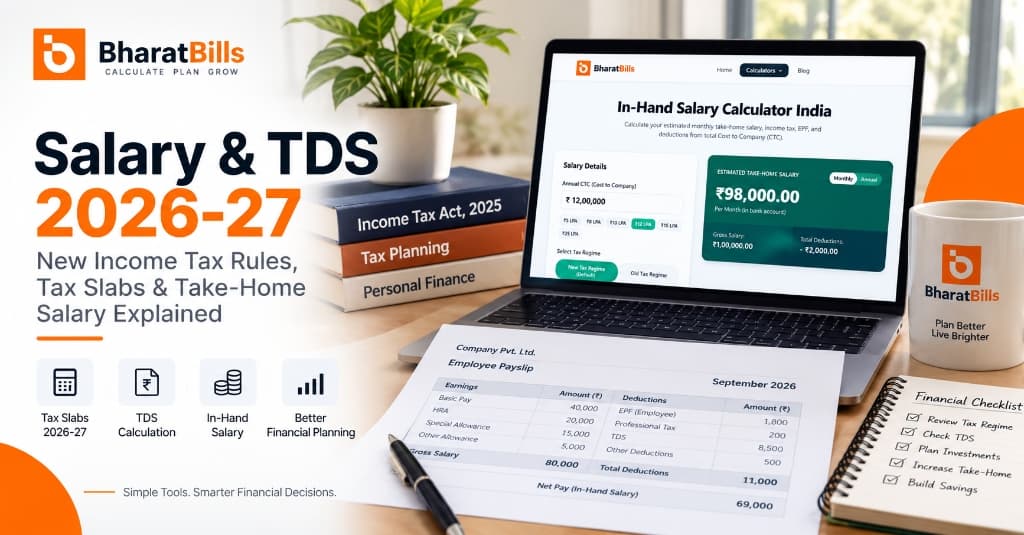
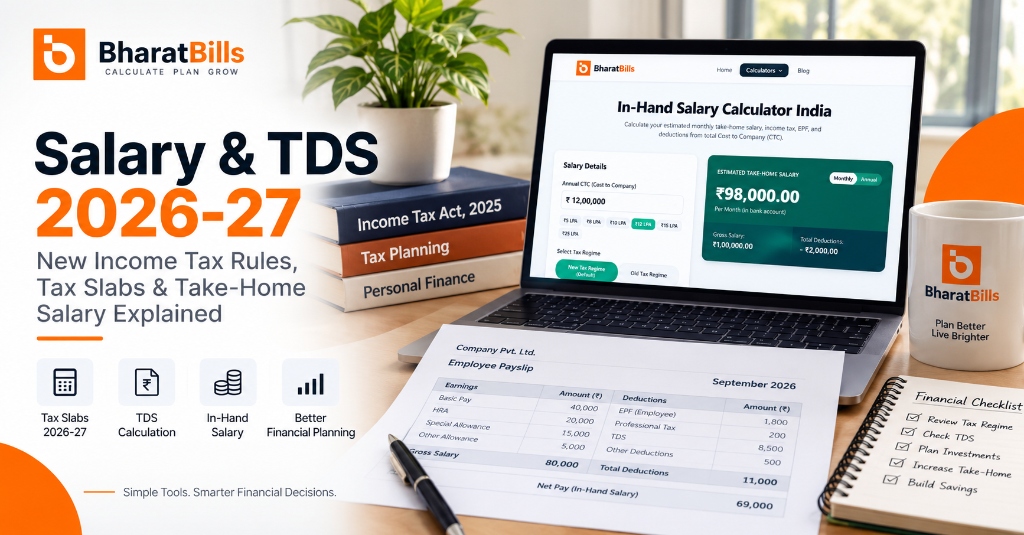
Salary TDS 2026-27: New Income Tax Rules, Tax Slabs & Take-Home Salary Explained
Direct Summary: For income earned between April 1, 2026 and March 31, 2027 (statutorily designated as Tax Year 2026-27 under the Income Tax Act, 2025), monthly salary Tax Deduction at Source (TDS) under Section 192 is governed by restructured New Tax Regime slabs and an enhanced standard deduction. Salaried employees benefit from a flat ₹75,000 standard deduction and a revised Section 87A rebate ceiling of ₹12 Lakh. This ensures that an employee whose total taxable salary does not exceed ₹12.75 Lakh incurs zero net income tax liability, provided they have no unadjusted non-salary earnings. However, once taxable salary crosses ₹12.75 Lakh, marginal relief rules apply, and monthly TDS is deducted pro-rata by employers across remaining payslips. Understanding your CTC breakdown, tax regime selection, and monthly withholding is essential to avoiding surprise year-end deductions.
What Is Tax Year 2026-27?
Under the modernized direct tax framework, the traditional dichotomy between "Financial Year (FY)" and "Assessment Year (AY)" has been rationalized to align with international direct tax standards. For all income earned from April 1, 2026 onward, the applicable period is designated as Tax Year 2026-27.
| Earning Period | Modern Statutory Term | Historical Equivalent | Governing Statute | Tax Return Filing Due Date |
|---|---|---|---|---|
| Apr 1, 2026 – Mar 31, 2027 | Tax Year 2026-27 | FY 2026-27 / AY 2027-28 | Income Tax Act, 2025 | July 31, 2027 (Salaried) |
| Apr 1, 2025 – Mar 31, 2026 | Historical Earning Year | FY 2025-26 / AY 2026-27 | Income Tax Act, 1961 | July 31, 2026 (Past Filing) |
Which Income Tax Act Applies to Salary in 2026-27?
For current payroll processing and monthly salary withholding in 2026-27, employers operate under the Income Tax Act, 2025. It is essential to recognize that the historical Income Tax Act, 1961 has not vanished entirely; its statutory provisions continue to govern past assessments, historical appellate proceedings, and reassessments for earlier financial years. For your day-to-day payslip, standard deduction claims, and current TDS withholding, the 2025 Act represents the active statutory ground truth.
New Tax Regime Slabs for 2026-27
The New Tax Regime serves as the default tax system for all Indian salaried taxpayers. The statutory income slabs for Tax Year 2026-27 are structured as follows:
| Taxable Income Slab (After ₹75K Std Deduction) | Statutory Tax Rate | Base Tax in Slab | Cumulative Base Tax |
|---|---|---|---|
| Up to ₹4,00,000 | Nil (0%) | ₹0 | ₹0 |
| ₹4,00,001 to ₹8,00,000 | 5% | ₹20,000 | ₹20,000 |
| ₹8,00,001 to ₹12,00,000 | 10% | ₹40,000 | ₹60,000 |
| ₹12,00,001 to ₹16,00,000 | 15% | ₹60,000 | ₹1,20,000 |
| ₹16,00,001 to ₹20,00,000 | 20% | ₹80,000 | ₹2,00,000 |
| ₹20,00,001 to ₹24,00,000 | 25% | ₹1,00,000 | ₹3,00,000 |
| Above ₹24,00,000 | 30% | 30% on excess | ₹3,00,000 + 30% of (Income − ₹24L) |
What Is TDS on Salary?
Under Section 192 of the Income Tax Act, employers are statutorily mandated to deduct income tax at source from salaried employees at the time of monthly salary disbursement. Rather than paying tax in one lump sum at the end of the year, TDS spreads your annual tax obligation across 12 equal monthly installments.
How Salary TDS Is Calculated
Every employer's payroll software follows an exact statutory sequence to compute your monthly withholding:
- Estimate Annual Gross Salary: Basic pay + HRA + Special Allowance + performance bonuses expected over 12 months.
- Subtract Exemptions & Deductions: Subtract ₹75,000 standard deduction (under New Regime) or 80C/80D/HRA exemptions (under Old Regime).
- Arrive at Net Taxable Income: Gross salary minus admissible deductions.
- Compute Slab Tax: Apply the statutory slab schedule to calculate raw annual tax.
- Apply Rebate / Marginal Relief: Deduct Section 87A rebate if taxable income is ≤ ₹12 Lakh, or apply marginal relief if taxable income is just above ₹12 Lakh.
- Add 4% Cess: Calculate 4% Health & Education Cess on net tax.
- Divide by Remaining Months: Subtract TDS already deducted in prior months of the tax year and divide the balance across remaining pay cycles.
CTC vs Gross Salary vs In-Hand Salary
Cost to Company (CTC) is the total annual expense an employer commits to maintaining an employee. It is not the amount deposited into your bank account:
| Salary Component | What It Represents | Accounting Category |
|---|---|---|
| CTC (Cost to Company) | Total annual corporate cost, including employer PF (12%) and gratuity provisions | Offer Letter Figure |
| Gross Salary | Earnings before deductions: Basic + HRA + Allowances (excludes employer PF) | Payslip Earnings Total |
| Employee PF (EPF) | 12% of basic salary deducted for your retirement corpus with EPFO | Statutory Deduction |
| Professional Tax (PT) | State tax capped at ₹2,500/year (typically ₹200/month in states like MH, KA, TS) | State Deduction |
| Salary TDS | Section 192 income tax withheld on behalf of the Central Government | Income Tax Withholding |
| Net Take-Home Pay | Actual funds credited to your bank account: Gross Salary − (EPF + PT + TDS) | Bank Credit Total |
Use the BharatBills In-Hand Salary Calculator to test your exact CTC and payslip components.
₹5 Lakh, ₹8 Lakh, ₹10 Lakh, ₹12 Lakh, ₹15 Lakh and ₹20 Lakh Salary Examples
Below is a comprehensive illustrative breakdown under the default New Tax Regime for Tax Year 2026-27.
ILLUSTRATIVE PLANNING ASSUMPTIONS: Basic pay assumed at 50% of gross, employee EPF at 12% of basic, professional tax at ₹200/month (₹2,400/year), and standard deduction of ₹75,000. Actual corporate CTC structures vary by employer.
| Annual Gross | Std Deduction | Taxable Salary | Annual Tax (incl Cess) | Monthly TDS | Monthly EPF (12%) | Est. Monthly In-Hand |
|---|---|---|---|---|---|---|
| ₹5,00,000 | ₹75,000 | ₹4,25,000 | ₹0 (87A Rebate) | ₹0 | ₹2,500 | ₹38,967 |
| ₹8,00,000 | ₹75,000 | ₹7,25,000 | ₹0 (87A Rebate) | ₹0 | ₹4,000 | ₹62,467 |
| ₹10,00,000 | ₹75,000 | ₹9,25,000 | ₹0 (87A Rebate) | ₹0 | ₹5,000 | ₹78,133 |
| ₹12,00,000 | ₹75,000 | ₹11,25,000 | ₹0 (87A Rebate) | ₹0 | ₹6,000 | ₹93,800 |
| ₹15,00,000 | ₹75,000 | ₹14,25,000 | ₹97,500 | ₹8,125 | ₹7,500 | ₹1,09,175 |
| ₹20,00,000 | ₹75,000 | ₹19,25,000 | ₹1,92,400 | ₹16,033 | ₹10,000 | ₹1,40,434 |
Why Your TDS May Look Different From Your Friend's
Two employees with identical CTC packages of ₹15 Lakh can have significantly different monthly TDS deductions and take-home pay. Key causes include:
- Basic Salary Proportion: An employer structuring 40% basic incurs less EPF deduction (higher immediate taxable pay) compared to one with 50% basic pay.
- Tax Regime Selection: If one colleague opted for the Old Regime with substantial home loan interest and 80C deductions, their taxable income diverges.
- Declaration Deadlines: In January and February, employers require actual investment proof submissions. Employees who fail to submit proofs face steep clawback TDS deductions in their February and March payslips.
- Other Income Declaration: Declaring high savings bank or fixed deposit interest on Form 12BB increases your employer's TDS withholding. Use our TDS Calculator to project withholding.
New Tax Regime vs Old Tax Regime for Salary
Neither regime is universally superior for every taxpayer. The optimal choice depends entirely on your total allowable deductions:
| Comparison Factor | New Tax Regime (Default) | Old Tax Regime (Optional) |
|---|---|---|
| Standard Deduction | ₹75,000 | ₹50,000 |
| Zero Tax Threshold | Up to ₹12.75 Lakh Gross | Up to ₹5.50 Lakh (with 87A) |
| Section 80C Deductions | Not Admissible | Up to ₹1,50,000 (PPF, ELSS, EPF, LIC) |
| Section 80D Health Insurance | Not Admissible | Up to ₹25,000 (₹50,000 for seniors) |
| House Rent Allowance (HRA) | Not Admissible | Exempt under Section 10(13A) |
| Home Loan Interest (Sec 24b) | Not Admissible for self-occupied | Up to ₹2,00,000 on self-occupied house |
| Break-Even Point | Old regime typically saves tax only if your total combined deductions (80C + 80D + HRA + Home Loan Interest) exceed ₹4.25 Lakh to ₹4.75 Lakh. | |
Marginal Relief: How Tax Works When Income Crosses ₹12.75 Lakh
A common anxiety among salaried professionals is crossing the ₹12.75 Lakh gross salary mark. Under standard slab rates, if your taxable income after standard deduction is ₹12,10,000 (just ₹10,000 above the ₹12 Lakh rebate threshold), raw slab tax would amount to ₹61,500. It would be grossly inequitable for an employee earning an extra ₹10,000 to suffer ₹61,500 in additional tax liability.
The Income Tax Act resolves this through Marginal Relief: the tax payable cannot exceed the exact incremental income earned above ₹12,00,000. Here is how payroll software computes it:
This statutory safeguard ensures that a modest appraisal, performance bonus, or overtime increment never leaves an employee with lower post-tax take-home pay.
How HRA Changes Your Salary Tax
House Rent Allowance (HRA) exemption operates strictly under the Old Tax Regime. Under Section 10(13A), your tax exemption is computed as the lowest of three statutory limits:
- Actual HRA received from your employer.
- 50% of basic salary for metro cities (Delhi, Mumbai, Kolkata, Chennai) or 40% for non-metro locations.
- Actual rent paid minus 10% of basic salary.
Under the New Tax Regime, HRA is fully taxable as regular income with zero exemption. If you pay substantial house rent in a metro city, use the BharatBills HRA Calculator to determine if switching to the Old Regime provides net tax savings.
How EPF Changes Take-Home Salary
Employee Provident Fund (EPF) deductions represent mandatory retirement savings rather than a tax:
- Statutory Wage Ceiling: The Employees' Provident Funds Scheme specifies a statutory wage ceiling of ₹15,000 per month, yielding a mandatory cap of ₹1,800/month.
- Actual Basic Contribution: Most corporate employers deduct 12% of actual basic salary without capping at ₹1,800, building a larger tax-exempt compounding retirement corpus.
- Taxability: Employee EPF contributions earn guaranteed annual interest (currently 8.25%), which remains completely tax-free up to an annual contribution limit of ₹2,500,000.
How TDS Appears on Your Payslip
A standard Indian corporate monthly payslip organizes compensation into parallel columns of earnings and deductions:
| Earnings Component | Amount (₹) | Deductions Component | Amount (₹) |
|---|---|---|---|
| Basic Salary | ₹62,500 | Employee PF (12%) | ₹7,500 |
| House Rent Allowance | ₹31,250 | Professional Tax | ₹200 |
| Special / Flexi Allowance | ₹31,250 | Income Tax (TDS) | ₹8,125 |
| Total Gross Earnings | ₹1,25,000 | Total Deductions | ₹15,825 |
| Net Disbursed Take-Home Pay (Bank Credit) | ₹1,09,175 | ||
How To Check Whether Your Employer Is Deducting Correct TDS
- 1. Verify Projected Tax Statement: Download the annual tax computation sheet from your company's HR/payroll portal in April/May to check assumed income and slab rates.
- 2. Confirm Tax Regime Choice: Verify that payroll correctly registered your election (New Regime vs Old Regime) in their internal records.
- 3. Submit Form 12BB on Time: Disclose rent receipts, health insurance, and 80C declarations before your company's cut-off date to prevent year-end TDS spikes.
- 4. Inspect Quarterly Form 26AS / AIS: Log into the Income Tax Department portal (eportal.incometax.gov.in) to verify that your employer has deposited your TDS with your exact PAN.
- 5. Collect Form 16 (Part A & Part B): By June 15 following the end of the tax year, obtain Form 16 to confirm total tax withheld matches your payslips.
Salary TDS FAQ
What is Tax Year 2026-27?
Tax Year 2026-27 refers to the earning period from April 1, 2026 to March 31, 2027 under the Income Tax Act, 2025 (historically corresponding to FY 2026-27 / AY 2027-28).
Which Income Tax Act applies to salary in 2026-27?
Contemporary salary withholding, standard deduction, and tax returns for income earned from April 1, 2026 are governed by the Income Tax Act, 2025.
How is salary TDS calculated?
Your employer estimates your annual gross salary, subtracts eligible standard deductions and exemptions, calculates tax per statutory slabs, applies Section 87A rebate and 4% cess, and divides by 12 months.
What is the standard deduction for salaried employees in Tax Year 2026-27?
Under the New Tax Regime, the standard deduction is ₹75,000. Under the Old Tax Regime, it remains ₹50,000.
What is the Section 87A rebate in Tax Year 2026-27?
Resident individuals whose taxable income does not exceed ₹12,00,000 receive a 100% tax rebate (up to a maximum rebate of ₹60,000) under the New Tax Regime, resulting in zero net tax.
Why is my monthly TDS different in January, February, or March?
If investment proofs (HRA rent receipts, 80C investments) are not submitted before your company's January cut-off, your employer recalculates annual tax without those deductions and claws back the shortfall in final payslips.
Can my TDS change during the year?
Yes. Salary appraisals, mid-year performance bonuses, regime switches, or declaring additional non-salary income directly alter your monthly withholding.
Does HRA reduce TDS under the New Tax Regime?
No. HRA exemption is not admissible under the New Tax Regime. HRA can only reduce taxable income if you elect to file under the Old Tax Regime.
Does Employee Provident Fund (EPF) reduce taxable salary?
Under the Old Regime, employee EPF qualifies for Section 80C deduction up to ₹1.5 Lakh. Under the New Regime, employee EPF is not deductible, though employer EPF contributions up to 12% remain non-taxable.
Why does CTC differ from net take-home salary?
CTC includes non-cash costs like employer PF contributions, gratuity provisioning, and insurance. From gross salary, employee EPF, professional tax, and monthly TDS are subtracted before money hits your bank account.
Related BharatBills Financial Calculators
Plan your compensation, taxes, and retirement with our verified financial calculators:
Sources & References
Put the principles from this guide into practice with our free calculators:
Related Guides & Articles
New Tax Regime vs Old Tax Regime: Which Saves More Tax in FY 2025-26?
Complete comparison of new and old income tax regimes in India for FY 2025-26. Understand Section 115BAC slabs, standard deduction, 87A rebate, and calculate which saves you more.
Advance Tax Payment Guide: Due Dates, Calculation & Avoiding Interest
Step-by-step guide to advance tax for salaried individuals with other income, freelancers, and businesses. Quarterly installment schedules and section 234B/234C penalties.
HRA Exemption: Rules, 3-Condition Formula & Rent Receipt Guide
Maximize your House Rent Allowance tax exemption under the Old Tax Regime. Understand metro vs non-metro limits, 10% basic rule, and landlord PAN requirements.